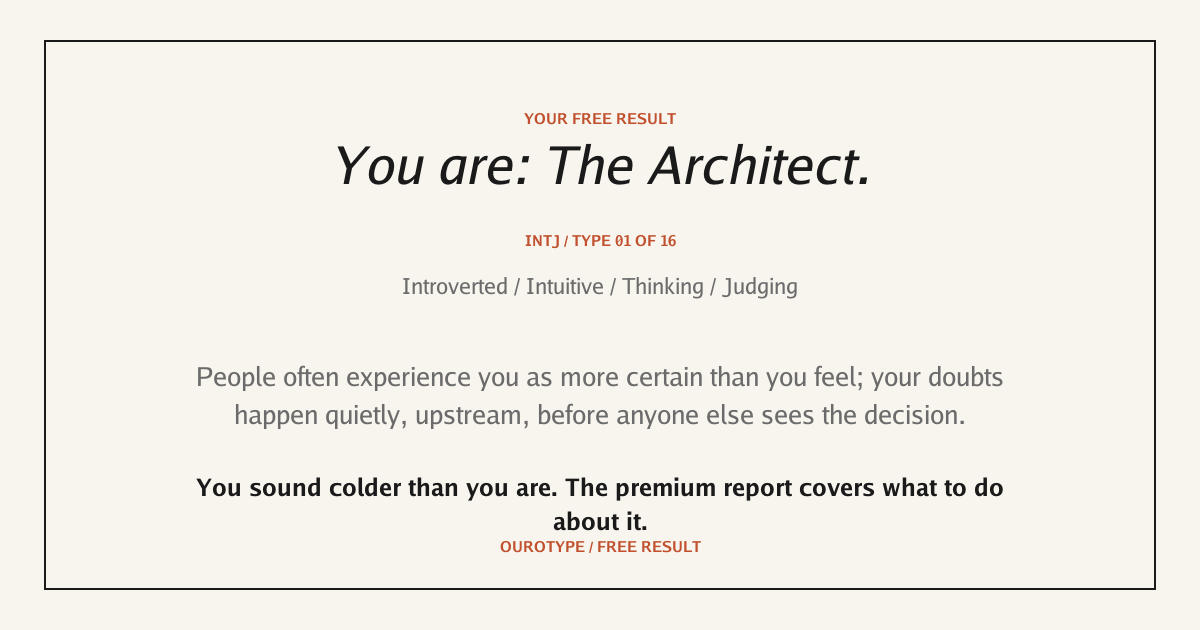
You are: The Architect.
Type 01 of 16 · Introverted · Intuitive · Thinking · Judging
You build mental systems for things other people experience as feelings. You're patient with ideas and impatient with people who repeat themselves. You'd rather be alone in a library than in any room with small talk. People who actually know you find you warmer than the version they expected.
Three strengths
- Spotting the structural problem in five minutes that the team has been talking around for six months.
- Holding two contradictory ideas in your head long enough to find the third one neither side considered.
- Deciding once, then not relitigating. (Other types find this terrifying. It's a strength.)
Two blind spots
- Forgetting that a correct answer still has to survive contact with human timing, pride, and fear.
- Mistaking emotional repetition for intellectual unseriousness when someone is actually asking to feel understood.
People often experience you as more certain than you feel; your doubts happen quietly, upstream, before anyone else sees the decision.
Three scenes from the longer read
A type becomes useful when it meets real life. Here is how this pattern tends to appear at work, in relationships, and at the edge of growth.
How you work
You work best with a closed door and an open problem. Interruptions don’t just cost you the interrupted minute; they cost you the reconstruction of the entire model you were holding in your head, which can take twenty minutes to rebuild and which sometimes doesn’t come back at all. This is why you guard your time like a resource that doesn’t refill, because for you it genuinely doesn’t refill quickly, and why the open-plan office is a special kind of hell you’ve learned to survive with headphones and a visible do-not-approach energy that people have learned to respect and slightly fear.
In relationships
You love by building. You don’t say the warm thing; you fix the broken thing, remember the important date, solve the problem your person mentioned once in passing three weeks ago and assumed you’d forgotten. To you this is devotion, and it genuinely is, a deep and reliable kind that a lot of louder lovers can’t match. The trouble is that the people closest to you sometimes want the warm thing said, out loud, in actual words, in real time, and the fact that you find saying-it redundant when you’ve already shown it does not make it redundant to them. Different people receive love in different currencies, and you’ve been paying in the one currency you personally value, and then feeling unappreciated when it doesn’t land, without noticing that you never learned their currency.
Where you grow
Growth for you is not more competence. You have plenty, and reaching for more of it when you’re stuck is just retreating to your strong hand because the game got hard on your weak one. Growth is emotional bandwidth: the capacity to stay present with another person’s feelings without immediately converting them into a problem to solve. When someone brings you a hurt, they usually want it witnessed before, or instead of, fixed. Practice witnessing. Say “that sounds really hard,” and then, harder than any technical challenge you’ll ever attempt, stop talking. Let the silence hold the feeling instead of filling it with a solution. This will feel useless to you. It is the opposite of useless. It is the thing.
A quiet little proof-of-result.
Post it, keep it, or send it to the person who guessed your type wrong.
Your 18-page read.
Unlock your 18-page report: strengths, blind spots, career fit, relationship patterns, money style, leadership style, and personalized action plan.
You sound colder than you are. The premium report covers what to do about it.
For self-reflection only. Not a clinical, medical, or hiring instrument. Inspired by Jungian type theory. Not affiliated with Myers-Briggs® or 16Personalities®. Results are descriptive, not definitive.